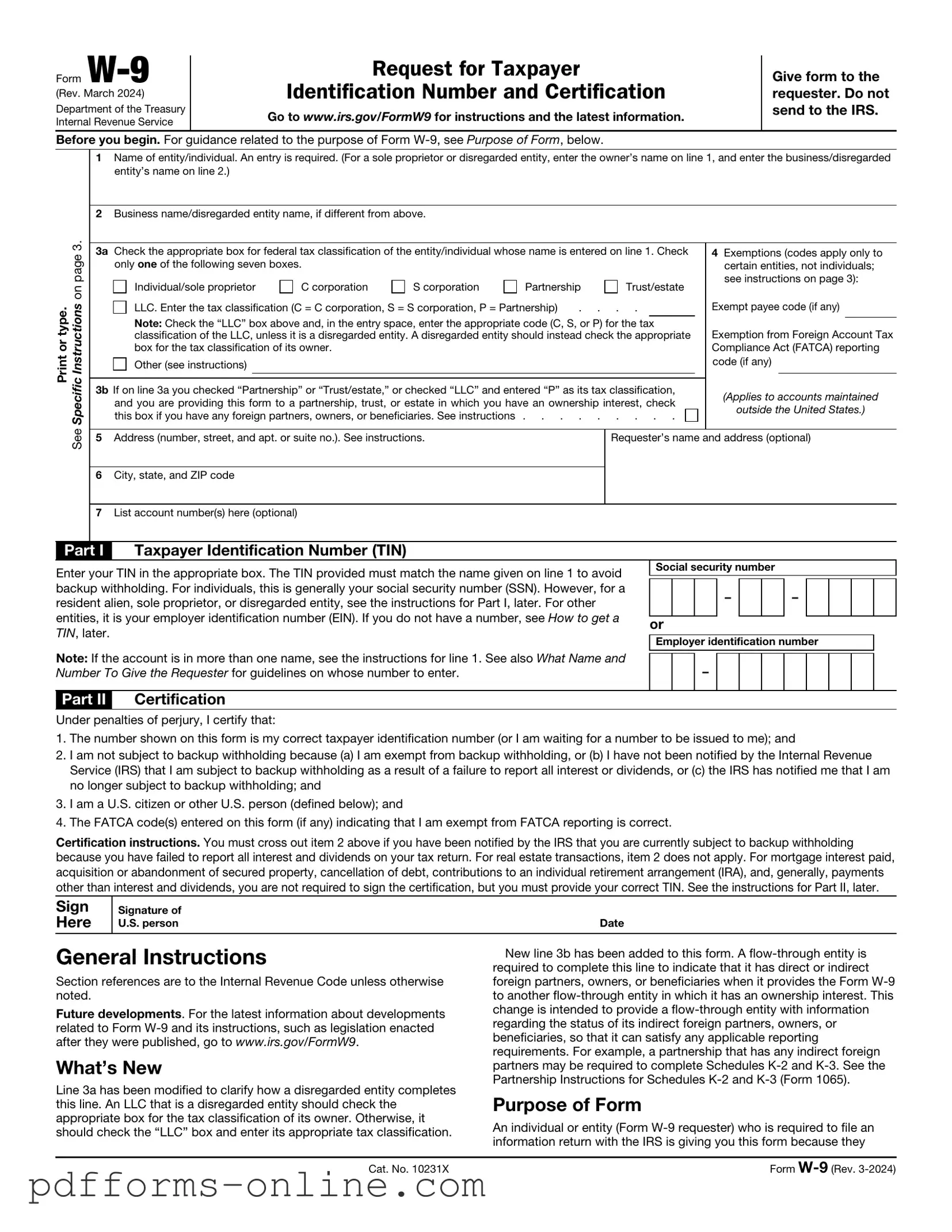
Blank IRS W-9 Template
The IRS W-9 form plays a crucial role in the financial interactions between individuals and businesses in the United States. It is primarily used to provide accurate taxpayer information, including the name, address, and taxpayer identification number (TIN) of the individual or entity completing the form. This information is essential for various financial transactions, such as freelance work, contract services, or any scenario where payments are made that require reporting to the IRS. By submitting a W-9, the requester can ensure they have the correct details on file, which helps prevent issues related to tax reporting. Additionally, the form is often a prerequisite for issuing a 1099 form, which reports income paid to non-employees. Understanding the W-9 form is vital for anyone involved in business transactions, as it helps maintain compliance with tax regulations and facilitates smooth financial operations.
Document Example
Form
(Rev. March 2024)
Department of the Treasury
Internal Revenue Service
Request for Taxpayer
Identification Number and Certification
Go to www.irs.gov/FormW9 for instructions and the latest information.
Give form to the requester. Do not send to the IRS.
Before you begin. For guidance related to the purpose of Form
1Name of entity/individual. An entry is required. (For a sole proprietor or disregarded entity, enter the owner’s name on line 1, and enter the business/disregarded entity’s name on line 2.)
2Business name/disregarded entity name, if different from above.
|
3. |
|
|
|
|
|
|
|
|
|
|
|
|
|
3a Check the appropriate box for federal tax classification of the entity/individual whose name is entered on line 1. Check |
|
4 Exemptions (codes apply only to |
||||||||||
|
page |
|
|||||||||||
|
only one of the following seven boxes. |
|
|
|
|
|
|
certain entities, not individuals; |
|||||
|
|
|
|
|
|
|
|
||||||
|
on |
Individual/sole proprietor |
C corporation |
S corporation |
Partnership |
Trust/estate |
|
see instructions on page 3): |
|||||
|
|
|
|
|
|||||||||
|
|
|
|
|
|
|
|
|
|
|
|
|
|
type.orPrint |
InstructionsSpecific |
LLC. Enter the tax classification (C = C corporation, S = S corporation, P = Partnership) |
. . . . |
|
|
Exempt payee code (if any) |
|||||||
Note: Check the “LLC” box above and, in the entry space, enter the appropriate code (C, S, or P) for the tax |
|
|
|
|
|||||||||
|
|
|
Exemption from Foreign Account Tax |
||||||||||
|
|
classification of the LLC, unless it is a disregarded entity. A disregarded entity should instead check the appropriate |
|
||||||||||
|
|
box for the tax classification of its owner. |
|
|
|
|
|
|
Compliance Act (FATCA) reporting |
||||
|
|
Other (see instructions) |
|
|
|
|
|
|
|
code (if any) |
|||
|
|
|
|
|
|
|
|
|
|||||
|
|
|
|
|
|
|
|
||||||
|
|
3b If on line 3a you checked “Partnership” or “Trust/estate,” or checked “LLC” and entered “P” as its tax classification, |
|
(Applies to accounts maintained |
|||||||||
|
|
and you are providing this form to a partnership, trust, or estate in which you have an ownership interest, check |
|
||||||||||
|
|
|
outside the United States.) |
||||||||||
|
|
this box if you have any foreign partners, owners, or beneficiaries. See instructions |
|
||||||||||
|
|
|
|
|
|
||||||||
|
See |
|
|
|
|
|
|
|
|
|
|
|
|
|
5 Address (number, street, and apt. or suite no.). See instructions. |
|
|
Requester’s name and address (optional) |
|||||||||
|
|
|
|
||||||||||
|
|
|
|
|
|
|
|
|
|
|
|
|
|
|
|
6 City, state, and ZIP code |
|
|
|
|
|
|
|
|
|
|
|
|
|
|
|
|
|
|
|
|
|
|
|
|
|
7List account number(s) here (optional)
Part I Taxpayer Identification Number (TIN)
Enter your TIN in the appropriate box. The TIN provided must match the name given on line 1 to avoid backup withholding. For individuals, this is generally your social security number (SSN). However, for a resident alien, sole proprietor, or disregarded entity, see the instructions for Part I, later. For other entities, it is your employer identification number (EIN). If you do not have a number, see How to get a TIN, later.
Note: If the account is in more than one name, see the instructions for line 1. See also What Name and Number To Give the Requester for guidelines on whose number to enter.
Part II Certification
Social security number
– |
– |
or
Employer identification number
–
Under penalties of perjury, I certify that:
1.The number shown on this form is my correct taxpayer identification number (or I am waiting for a number to be issued to me); and
2.I am not subject to backup withholding because (a) I am exempt from backup withholding, or (b) I have not been notified by the Internal Revenue Service (IRS) that I am subject to backup withholding as a result of a failure to report all interest or dividends, or (c) the IRS has notified me that I am no longer subject to backup withholding; and
3.I am a U.S. citizen or other U.S. person (defined below); and
4.The FATCA code(s) entered on this form (if any) indicating that I am exempt from FATCA reporting is correct.
Certification instructions. You must cross out item 2 above if you have been notified by the IRS that you are currently subject to backup withholding because you have failed to report all interest and dividends on your tax return. For real estate transactions, item 2 does not apply. For mortgage interest paid, acquisition or abandonment of secured property, cancellation of debt, contributions to an individual retirement arrangement (IRA), and, generally, payments other than interest and dividends, you are not required to sign the certification, but you must provide your correct TIN. See the instructions for Part II, later.
Sign |
Signature of |
|
Here |
U.S. person |
Date |
General Instructions |
New line 3b has been added to this form. A |
|
|
||
|
required to complete this line to indicate that it has direct or indirect |
|
Section references are to the Internal Revenue Code unless otherwise |
foreign partners, owners, or beneficiaries when it provides the Form |
|
noted. |
to another |
|
Future developments. For the latest information about developments |
change is intended to provide a |
|
regarding the status of its indirect foreign partners, owners, or |
||
related to Form |
||
beneficiaries, so that it can satisfy any applicable reporting |
||
after they were published, go to www.irs.gov/FormW9. |
||
requirements. For example, a partnership that has any indirect foreign |
||
What’s New |
||
partners may be required to complete Schedules |
||
Line 3a has been modified to clarify how a disregarded entity completes |
Partnership Instructions for Schedules |
|
Purpose of Form |
||
this line. An LLC that is a disregarded entity should check the |
||
appropriate box for the tax classification of its owner. Otherwise, it |
An individual or entity (Form |
|
should check the “LLC” box and enter its appropriate tax classification. |
||
information return with the IRS is giving you this form because they |
||
|
Cat. No. 10231X |
Form |
Form |
Page 2 |
must obtain your correct taxpayer identification number (TIN), which may be your social security number (SSN), individual taxpayer identification number (ITIN), adoption taxpayer identification number (ATIN), or employer identification number (EIN), to report on an information return the amount paid to you, or other amount reportable on an information return. Examples of information returns include, but are not limited to, the following.
•Form
•Form
•Form
•Form
•Form
•Form
•Form
•Form 1098 (home mortgage interest),
•Form
•Form
Use Form
Caution: If you don’t return Form
By signing the
1.Certify that the TIN you are giving is correct (or you are waiting for a number to be issued);
2.Certify that you are not subject to backup withholding; or
3.Claim exemption from backup withholding if you are a U.S. exempt payee; and
4.Certify to your
5.Certify that FATCA code(s) entered on this form (if any) indicating that you are exempt from the FATCA reporting is correct. See What Is FATCA Reporting, later, for further information.
Note: If you are a U.S. person and a requester gives you a form other than Form
Definition of a U.S. person. For federal tax purposes, you are considered a U.S. person if you are:
•An individual who is a U.S. citizen or U.S. resident alien;
•A partnership, corporation, company, or association created or organized in the United States or under the laws of the United States;
•An estate (other than a foreign estate); or
•A domestic trust (as defined in Regulations section
Establishing U.S. status for purposes of chapter 3 and chapter 4 withholding. Payments made to foreign persons, including certain distributions, allocations of income, or transfers of sales proceeds, may be subject to withholding under chapter 3 or chapter 4 of the Code (sections
The following persons must provide Form
•In the case of a disregarded entity with a U.S. owner, the U.S. owner of the disregarded entity and not the disregarded entity.
•In the case of a grantor trust with a U.S. grantor or other U.S. owner, generally, the U.S. grantor or other U.S. owner of the grantor trust and not the grantor trust.
•In the case of a U.S. trust (other than a grantor trust), the U.S. trust and not the beneficiaries of the trust.
See Pub. 515 for more information on providing a Form
Foreign person. If you are a foreign person or the U.S. branch of a foreign bank that has elected to be treated as a U.S. person (under Regulations section
Nonresident alien who becomes a resident alien. Generally, only a nonresident alien individual may use the terms of a tax treaty to reduce or eliminate U.S. tax on certain types of income. However, most tax treaties contain a provision known as a saving clause. Exceptions specified in the saving clause may permit an exemption from tax to continue for certain types of income even after the payee has otherwise become a U.S. resident alien for tax purposes.
If you are a U.S. resident alien who is relying on an exception contained in the saving clause of a tax treaty to claim an exemption from U.S. tax on certain types of income, you must attach a statement to Form
1.The treaty country. Generally, this must be the same treaty under which you claimed exemption from tax as a nonresident alien.
2.The treaty article addressing the income.
3.The article number (or location) in the tax treaty that contains the saving clause and its exceptions.
4.The type and amount of income that qualifies for the exemption from tax.
5.Sufficient facts to justify the exemption from tax under the terms of the treaty article.
Example. Article 20 of the
If you are a nonresident alien or a foreign entity, give the requester the appropriate completed Form
Backup Withholding
What is backup withholding? Persons making certain payments to you must under certain conditions withhold and pay to the IRS 24% of such payments. This is called “backup withholding.” Payments that may be subject to backup withholding include, but are not limited to, interest,
You will not be subject to backup withholding on payments you receive if you give the requester your correct TIN, make the proper certifications, and report all your taxable interest and dividends on your tax return.
Payments you receive will be subject to backup withholding if:
1.You do not furnish your TIN to the requester;
2.You do not certify your TIN when required (see the instructions for Part II for details);
3.The IRS tells the requester that you furnished an incorrect TIN;
4.The IRS tells you that you are subject to backup withholding
because you did not report all your interest and dividends on your tax return (for reportable interest and dividends only); or
5.You do not certify to the requester that you are not subject to backup withholding, as described in item 4 under “By signing the filled- out form” above (for reportable interest and dividend accounts opened after 1983 only).
Form |
Page 3 |
Certain payees and payments are exempt from backup withholding. See Exempt payee code, later, and the separate Instructions for the Requester of Form
See also Establishing U.S. status for purposes of chapter 3 and chapter 4 withholding, earlier.
What Is FATCA Reporting?
The Foreign Account Tax Compliance Act (FATCA) requires a participating foreign financial institution to report all U.S. account holders that are specified U.S. persons. Certain payees are exempt from FATCA reporting. See Exemption from FATCA reporting code, later, and the Instructions for the Requester of Form
Updating Your Information
You must provide updated information to any person to whom you claimed to be an exempt payee if you are no longer an exempt payee and anticipate receiving reportable payments in the future from this person. For example, you may need to provide updated information if you are a C corporation that elects to be an S corporation, or if you are no longer tax exempt. In addition, you must furnish a new Form
Penalties
Failure to furnish TIN. If you fail to furnish your correct TIN to a requester, you are subject to a penalty of $50 for each such failure unless your failure is due to reasonable cause and not to willful neglect.
Civil penalty for false information with respect to withholding. If you make a false statement with no reasonable basis that results in no backup withholding, you are subject to a $500 penalty.
Criminal penalty for falsifying information. Willfully falsifying certifications or affirmations may subject you to criminal penalties including fines and/or imprisonment.
Misuse of TINs. If the requester discloses or uses TINs in violation of federal law, the requester may be subject to civil and criminal penalties.
Specific Instructions
Line 1
You must enter one of the following on this line; do not leave this line blank. The name should match the name on your tax return.
If this Form
•Individual. Generally, enter the name shown on your tax return. If you have changed your last name without informing the Social Security Administration (SSA) of the name change, enter your first name, the last name as shown on your social security card, and your new last name.
Note for ITIN applicant: Enter your individual name as it was entered on your Form
•Sole proprietor. Enter your individual name as shown on your Form 1040 on line 1. Enter your business, trade, or “doing business as” (DBA) name on line 2.
•Partnership, C corporation, S corporation, or LLC, other than a disregarded entity. Enter the entity’s name as shown on the entity’s tax return on line 1 and any business, trade, or DBA name on line 2.
•Other entities. Enter your name as shown on required U.S. federal tax documents on line 1. This name should match the name shown on the charter or other legal document creating the entity. Enter any business, trade, or DBA name on line 2.
•Disregarded entity. In general, a business entity that has a single owner, including an LLC, and is not a corporation, is disregarded as an entity separate from its owner (a disregarded entity). See Regulations section
example, if a foreign LLC that is treated as a disregarded entity for U.S. federal tax purposes has a single owner that is a U.S. person, the U.S. owner’s name is required to be provided on line 1. If the direct owner of the entity is also a disregarded entity, enter the first owner that is not disregarded for federal tax purposes. Enter the disregarded entity’s name on line 2. If the owner of the disregarded entity is a foreign person, the owner must complete an appropriate Form
Line 2
If you have a business name, trade name, DBA name, or disregarded entity name, enter it on line 2.
Line 3a
Check the appropriate box on line 3a for the U.S. federal tax classification of the person whose name is entered on line 1. Check only one box on line 3a.
IF the entity/individual on line 1 |
THEN check the box for . . . |
||
is a(n) . . . |
|
||
|
|
|
|
• |
Corporation |
Corporation. |
|
|
|
|
|
• |
Individual or |
Individual/sole proprietor. |
|
• |
Sole proprietorship |
|
|
|
|
|
|
• |
LLC classified as a partnership |
Limited liability company and |
|
for U.S. federal tax purposes or |
enter the appropriate tax |
||
• |
LLC that has filed Form 8832 or |
classification: |
|
P = Partnership, |
|||
2553 electing to be taxed as a |
|||
corporation |
C = C corporation, or |
||
|
|
S = S corporation. |
|
|
|
|
|
• |
Partnership |
Partnership. |
|
|
|
|
|
• |
Trust/estate |
Trust/estate. |
|
Line 3b
Check this box if you are a partnership (including an LLC classified as a partnership for U.S. federal tax purposes), trust, or estate that has any foreign partners, owners, or beneficiaries, and you are providing this form to a partnership, trust, or estate, in which you have an ownership interest. You must check the box on line 3b if you receive a Form
Note: A partnership that provides a Form
If you are required to complete line 3b but fail to do so, you may not receive the information necessary to file a correct information return with the IRS or furnish a correct payee statement to your partners or beneficiaries. See, for example, sections 6698, 6722, and 6724 for penalties that may apply.
Line 4 Exemptions
If you are exempt from backup withholding and/or FATCA reporting, enter in the appropriate space on line 4 any code(s) that may apply to you.
Exempt payee code.
•Generally, individuals (including sole proprietors) are not exempt from backup withholding.
•Except as provided below, corporations are exempt from backup withholding for certain payments, including interest and dividends.
•Corporations are not exempt from backup withholding for payments made in settlement of payment card or
•Corporations are not exempt from backup withholding with respect to attorneys’ fees or gross proceeds paid to attorneys, and corporations that provide medical or health care services are not exempt with respect to payments reportable on Form
The following codes identify payees that are exempt from backup withholding. Enter the appropriate code in the space on line 4.
Form |
Page 4 |
The following chart shows types of payments that may be exempt from backup withholding. The chart applies to the exempt payees listed above, 1 through 13.
IF the payment is for . . . |
THEN the payment is exempt |
|
for . . . |
|
|
• Interest and dividend payments |
All exempt payees except |
|
for 7. |
• Broker transactions |
Exempt payees 1 through 4 and 6 |
|
through 11 and all C corporations. |
|
S corporations must not enter an |
|
exempt payee code because they |
|
are exempt only for sales of |
|
noncovered securities acquired |
|
prior to 2012. |
• Barter exchange transactions |
Exempt payees 1 through 4. |
and patronage dividends |
|
• Payments over $600 required to |
Generally, exempt payees |
be reported and direct sales over |
1 through 5.2 |
$5,0001 |
|
• Payments made in settlement of |
Exempt payees 1 through 4. |
payment card or |
|
network transactions |
|
1See Form
2However, the following payments made to a corporation and reportable on Form
Exemption from FATCA reporting code. The following codes identify payees that are exempt from reporting under FATCA. These codes apply to persons submitting this form for accounts maintained outside of the United States by certain foreign financial institutions. Therefore, if you are only submitting this form for an account you hold in the United States, you may leave this field blank. Consult with the person requesting this form if you are uncertain if the financial institution is subject to these requirements. A requester may indicate that a code is not required by providing you with a Form
Note: You may wish to consult with the financial institution requesting this form to determine whether the FATCA code and/or exempt payee code should be completed.
Line 5
Enter your address (number, street, and apartment or suite number). This is where the requester of this Form
Line 6
Enter your city, state, and ZIP code.
Part I. Taxpayer Identification Number (TIN)
Enter your TIN in the appropriate box. If you are a resident alien and you do not have, and are not eligible to get, an SSN, your TIN is your IRS ITIN. Enter it in the entry space for the Social security number. If you do not have an ITIN, see How to get a TIN below.
If you are a sole proprietor and you have an EIN, you may enter either your SSN or EIN.
If you are a
Note: See What Name and Number To Give the Requester, later, for further clarification of name and TIN combinations.
How to get a TIN. If you do not have a TIN, apply for one immediately. To apply for an SSN, get Form
If you are asked to complete Form
Note: Entering “Applied For” means that you have already applied for a TIN or that you intend to apply for one soon. See also Establishing U.S. status for purposes of chapter 3 and chapter 4 withholding, earlier, for when you may instead be subject to withholding under chapter 3 or 4 of the Code.
Caution: A disregarded U.S. entity that has a foreign owner must use the appropriate Form
Form |
Page 5 |
Part II. Certification
To establish to the withholding agent that you are a U.S. person, or resident alien, sign Form
For a joint account, only the person whose TIN is shown in Part I should sign (when required). In the case of a disregarded entity, the person identified on line 1 must sign. Exempt payees, see Exempt payee code, earlier.
Signature requirements. Complete the certification as indicated in items 1 through 5 below.
1.Interest, dividend, and barter exchange accounts opened before 1984 and broker accounts considered active during 1983. You must give your correct TIN, but you do not have to sign the certification.
2.Interest, dividend, broker, and barter exchange accounts opened after 1983 and broker accounts considered inactive during 1983. You must sign the certification or backup withholding will apply. If you are subject to backup withholding and you are merely providing your correct TIN to the requester, you must cross out item 2 in the certification before signing the form.
3.Real estate transactions. You must sign the certification. You may cross out item 2 of the certification.
4.Other payments. You must give your correct TIN, but you do not have to sign the certification unless you have been notified that you have previously given an incorrect TIN. “Other payments” include payments made in the course of the requester’s trade or business for rents, royalties, goods (other than bills for merchandise), medical and health care services (including payments to corporations), payments to a nonemployee for services, payments made in settlement of payment card and
5.Mortgage interest paid by you, acquisition or abandonment of secured property, cancellation of debt, qualified tuition program payments (under section 529), ABLE accounts (under section 529A), IRA, Coverdell ESA, Archer MSA or HSA contributions or distributions, and pension distributions. You must give your correct TIN, but you do not have to sign the certification.
What Name and Number To Give the Requester
|
For this type of account: |
Give name and SSN of: |
|
|
|
1. |
Individual |
The individual |
2. |
Two or more individuals (joint account) |
The actual owner of the account or, |
|
other than an account maintained by |
if combined funds, the first individual |
|
an FFI |
on the account1 |
3. |
Two or more U.S. persons |
Each holder of the account |
|
(joint account maintained by an FFI) |
|
4. |
Custodial account of a minor |
The minor2 |
|
(Uniform Gift to Minors Act) |
|
5. a. The usual revocable savings trust |
The |
|
|
(grantor is also trustee) |
|
|
b. |
The actual owner1 |
|
a legal or valid trust under state law |
|
6. |
Sole proprietorship or disregarded |
The owner3 |
|
entity owned by an individual |
|
7. |
Grantor trust filing under Optional |
The grantor* |
|
Filing Method 1 (see Regulations |
|
|
section |
|
|
|
|
|
For this type of account: |
Give name and EIN of: |
|
|
|
8. |
Disregarded entity not owned by an |
The owner |
|
individual |
|
9. |
A valid trust, estate, or pension trust |
Legal entity4 |
10. |
Corporation or LLC electing corporate |
The corporation |
|
status on Form 8832 or Form 2553 |
|
11. |
Association, club, religious, charitable, |
The organization |
|
educational, or other |
|
|
organization |
|
12. |
Partnership or |
The partnership |
13. |
A broker or registered nominee |
The broker or nominee |
14. Account with the Department of |
The public entity |
|
|
Agriculture in the name of a public |
|
|
entity (such as a state or local |
|
|
government, school district, or prison) |
|
|
that receives agricultural program |
|
|
payments |
|
15. Grantor trust filing Form 1041 or |
The trust |
|
|
under the Optional Filing Method 2, |
|
|
requiring Form 1099 (see Regulations |
|
|
section |
|
|
|
|
1List first and circle the name of the person whose number you furnish. If only one person on a joint account has an SSN, that person’s number must be furnished.
2Circle the minor’s name and furnish the minor’s SSN.
3You must show your individual name on line 1, and enter your business or DBA name, if any, on line 2. You may use either your SSN or EIN (if you have one), but the IRS encourages you to use your SSN.
4List first and circle the name of the trust, estate, or pension trust. (Do not furnish the TIN of the personal representative or trustee unless the legal entity itself is not designated in the account title.)
*Note: The grantor must also provide a Form
**For more information on optional filing methods for grantor trusts, see the Instructions for Form 1041.
Note: If no name is circled when more than one name is listed, the number will be considered to be that of the first name listed.
Secure Your Tax Records From Identity Theft
Identity theft occurs when someone uses your personal information, such as your name, SSN, or other identifying information, without your permission to commit fraud or other crimes. An identity thief may use your SSN to get a job or may file a tax return using your SSN to receive a refund.
To reduce your risk:
•Protect your SSN,
•Ensure your employer is protecting your SSN, and
•Be careful when choosing a tax return preparer.
If your tax records are affected by identity theft and you receive a notice from the IRS, respond right away to the name and phone number printed on the IRS notice or letter.
If your tax records are not currently affected by identity theft but you think you are at risk due to a lost or stolen purse or wallet, questionable credit card activity, or a questionable credit report, contact the IRS Identity Theft Hotline at
For more information, see Pub. 5027, Identity Theft Information for Taxpayers.
Form |
Page 6 |
Victims of identity theft who are experiencing economic harm or a systemic problem, or are seeking help in resolving tax problems that have not been resolved through normal channels, may be eligible for Taxpayer Advocate Service (TAS) assistance. You can reach TAS by calling the TAS
Protect yourself from suspicious emails or phishing schemes. Phishing is the creation and use of email and websites designed to mimic legitimate business emails and websites. The most common act is sending an email to a user falsely claiming to be an established legitimate enterprise in an attempt to scam the user into surrendering private information that will be used for identity theft.
The IRS does not initiate contacts with taxpayers via emails. Also, the IRS does not request personal detailed information through email or ask taxpayers for the PIN numbers, passwords, or similar secret access information for their credit card, bank, or other financial accounts.
If you receive an unsolicited email claiming to be from the IRS, forward this message to phishing@irs.gov. You may also report misuse of the IRS name, logo, or other IRS property to the Treasury Inspector General for Tax Administration (TIGTA) at
Go to www.irs.gov/IdentityTheft to learn more about identity theft and how to reduce your risk.
Privacy Act Notice
Section 6109 of the Internal Revenue Code requires you to provide your correct TIN to persons (including federal agencies) who are required to file information returns with the IRS to report interest, dividends, or certain other income paid to you; mortgage interest you paid; the acquisition or abandonment of secured property; the cancellation of debt; or contributions you made to an IRA, Archer MSA, or HSA. The person collecting this form uses the information on the form to file information returns with the IRS, reporting the above information. Routine uses of this information include giving it to the Department of Justice for civil and criminal litigation and to cities, states, the District of Columbia, and U.S. commonwealths and territories for use in administering their laws. The information may also be disclosed to other countries under a treaty, to federal and state agencies to enforce civil and criminal laws, or to federal law enforcement and intelligence agencies to combat terrorism. You must provide your TIN whether or not you are required to file a tax return. Under section 3406, payors must generally withhold a percentage of taxable interest, dividends, and certain other payments to a payee who does not give a TIN to the payor. Certain penalties may also apply for providing false or fraudulent information.
Frequently Asked Questions
-
What is the IRS W-9 form?
The IRS W-9 form is a document used by individuals and businesses to provide their taxpayer identification information to another party. This form is commonly used by freelancers, independent contractors, and vendors to report income to the IRS.
-
Who needs to fill out a W-9 form?
Anyone who is required to provide their taxpayer identification number (TIN) to another person or business must fill out a W-9 form. This typically includes freelancers, contractors, and vendors who receive payment for services rendered.
-
What information is required on the W-9 form?
The W-9 form requires the following information:
- Your name
- Your business name (if applicable)
- Your address
- Your taxpayer identification number (either your Social Security Number or Employer Identification Number)
- Certification that the information provided is accurate
-
How is the W-9 form used?
The completed W-9 form is typically submitted to the person or business requesting it. They will use the information to prepare tax documents, such as the 1099 form, which reports payments made to you to the IRS.
-
Is the W-9 form submitted to the IRS?
No, the W-9 form is not submitted directly to the IRS. Instead, it is kept on file by the requester. They will use the information from your W-9 to report payments to the IRS on forms like the 1099.
-
What should I do if I make a mistake on my W-9 form?
If you notice an error after submitting your W-9, you should fill out a new W-9 form with the correct information and submit it to the requester. It's important to ensure that your information is accurate to avoid any issues with tax reporting.
-
How often do I need to submit a W-9 form?
You typically need to submit a W-9 form when you first start working with a new client or vendor. If your information changes, such as a change of address or a change in your business structure, you should submit a new form. Otherwise, you may not need to resubmit unless specifically requested.
-
Is the W-9 form secure?
While the W-9 form contains sensitive information, such as your Social Security Number or Employer Identification Number, it is generally safe when shared with legitimate businesses or individuals. However, be cautious and only provide it to trusted parties to protect your identity and personal information.
Misconceptions
The IRS W-9 form is a commonly used document, but several misconceptions surround its purpose and usage. Below are nine of these misconceptions explained.
- Misconception 1: The W-9 form is only for independent contractors.
- Misconception 2: Submitting a W-9 form means you will automatically be taxed.
- Misconception 3: You must submit a W-9 form every year.
- Misconception 4: The W-9 form is the same as the W-2 form.
- Misconception 5: Only U.S. citizens can fill out a W-9 form.
- Misconception 6: You should provide your Social Security number on the W-9 form.
- Misconception 7: The W-9 form is a tax return.
- Misconception 8: You can refuse to provide a W-9 form.
- Misconception 9: Once you submit a W-9 form, your information is public.
This is not entirely accurate. While independent contractors often use the W-9 form to provide their taxpayer information to clients, it can also be used by other entities, including corporations and partnerships, to report income to the IRS.
Providing a W-9 form does not mean that you will be taxed on the income reported. It simply provides the necessary information for the payer to report payments to the IRS.
Typically, a W-9 form is only required when there is a change in your information, such as a change in name or taxpayer identification number. Otherwise, it remains valid until the information changes.
The W-9 and W-2 forms serve different purposes. The W-9 is used to provide taxpayer information, while the W-2 is used by employers to report wages and taxes withheld for employees.
Non-U.S. citizens can also fill out a W-9 form if they have a valid taxpayer identification number and meet certain criteria.
While many individuals do use their Social Security number, it is not the only option. Taxpayer Identification Numbers (TINs) can also be used, especially for businesses.
The W-9 is not a tax return. It is a request for taxpayer information that helps the payer report payments to the IRS accurately.
While you can refuse to provide a W-9 form, doing so may result in backup withholding on payments you receive, as the payer may be required to withhold taxes.
The information on a W-9 form is not public. It is intended for use by the payer for tax reporting purposes and is kept confidential.
Common mistakes
-
Incorrect Name: People often use a business name instead of their legal name. The name on the W-9 should match the name on the tax return.
-
Wrong Taxpayer Identification Number (TIN): Individuals sometimes provide an incorrect Social Security Number (SSN) or Employer Identification Number (EIN). Double-checking the number is crucial.
-
Missing Signature: Some forget to sign the form. A signature is necessary to validate the information provided.
-
Failure to Indicate Exemptions: If applicable, individuals may neglect to indicate any exemptions. This can lead to unnecessary withholding.
-
Incorrect Address: Providing an outdated or incorrect address can cause delays in receiving important tax documents.
-
Not Updating the Form: People sometimes use an old W-9. If there are changes in name, address, or TIN, a new form should be submitted.
-
Ignoring Instructions: Some individuals overlook the instructions provided with the form. Reading the guidelines ensures accurate completion.
Additional PDF Templates
Planned Parenthood Doctors Note for Work - The form collects demographic and medical history for accurate service provision.
Utility Bill Generator - Ensure accurate reporting of all utility costs with this essential form.
Document Data
| Fact Name | Description |
|---|---|
| Purpose | The W-9 form is used to provide taxpayer information to the IRS, typically for independent contractors or freelancers. |
| Who Uses It | Businesses request the W-9 from individuals or entities they pay for services to ensure proper tax reporting. |
| Taxpayer Identification Number | Individuals must provide their Social Security Number (SSN) or businesses must provide their Employer Identification Number (EIN). |
| Filing Requirement | The W-9 is not submitted to the IRS; it is kept on file by the requester for their records. |
| Form Updates | The IRS periodically updates the W-9 form. Always use the latest version to ensure compliance. |
| State-Specific Forms | Some states have their own versions or requirements for tax forms. Check local regulations for compliance. |
| Backup Withholding | If a taxpayer does not provide a W-9, the payer may be required to withhold a percentage of payments for taxes. |
| Signature Requirement | The form must be signed and dated by the individual or authorized representative to validate the information. |
| Privacy Considerations | Providing a W-9 involves sharing sensitive information. Ensure it is handled securely to protect privacy. |
| Common Mistakes | Errors such as incorrect names or numbers can lead to issues with tax reporting. Double-check all entries. |
Similar forms
The IRS W-4 form is similar to the W-9 in that it is used for tax purposes, but it serves a different function. While the W-9 collects information about individuals or businesses that provide services, the W-4 is used by employees to indicate their tax withholding preferences to their employers. Both forms require personal information, such as name and Social Security number, but the W-4 focuses on withholding allowances and filing status to ensure accurate tax deductions from paychecks.
The 1099 form is another document closely related to the W-9. When a business pays an independent contractor or freelancer, it often requests a W-9 to obtain the contractor's taxpayer identification number. At the end of the year, the business uses the information from the W-9 to complete a 1099 form, which reports the income paid to the contractor to the IRS. This connection highlights the W-9’s role in facilitating accurate income reporting.
The 1040 form is the standard individual income tax return used in the United States. While the W-9 is primarily for information collection, the 1040 is the actual document where taxpayers report their income, deductions, and credits. Information from the W-9, particularly income reported on a 1099, is often included on the 1040, making the W-9 an essential precursor in the tax filing process.
The 1098 form, which reports mortgage interest paid, is another document that shares similarities with the W-9. Both forms require taxpayer identification information and are used to report financial transactions to the IRS. While the W-9 gathers information for independent contractors, the 1098 provides details to homeowners about interest payments, which can be deducted on their tax returns.
The Schedule C form is used by sole proprietors to report income and expenses from their business. Like the W-9, it requires detailed financial information, but the Schedule C focuses on the business’s profitability rather than just the identification of the taxpayer. If a business owner receives payments reported on a 1099 based on information from a W-9, they will use the Schedule C to report that income on their tax return.
The 4506-T form allows taxpayers to request a transcript of their tax return from the IRS. This document is similar to the W-9 in that it involves taxpayer identification and is often used in financial transactions, such as loan applications. Both forms help ensure that the IRS has accurate information about taxpayers, facilitating smooth financial processes.
The 8821 form is a tax information authorization form that allows taxpayers to designate someone else to receive their tax information. Like the W-9, it requires personal identification details, but its purpose is to grant authority rather than to collect information for reporting. This form ensures that the designated individual can access necessary tax documents, which can be crucial for managing finances or seeking professional assistance.
The 1065 form is used by partnerships to report income, deductions, and other tax-related information. While the W-9 is a request for taxpayer information, the 1065 is a comprehensive report of a partnership’s financial activities. Information gathered via W-9 forms from partners is often included in the 1065, illustrating how these documents work together in the tax reporting process.
Lastly, the K-1 form is issued to partners in a partnership or shareholders in an S corporation. It reports each partner's share of income, deductions, and credits. Similar to the W-9, the K-1 requires taxpayer identification and is used to report financial information to the IRS. The K-1 relies on the accurate information collected through the W-9, demonstrating the interconnectedness of these tax documents.